
Bear 750 PSV Infant Critical Care Ventilator
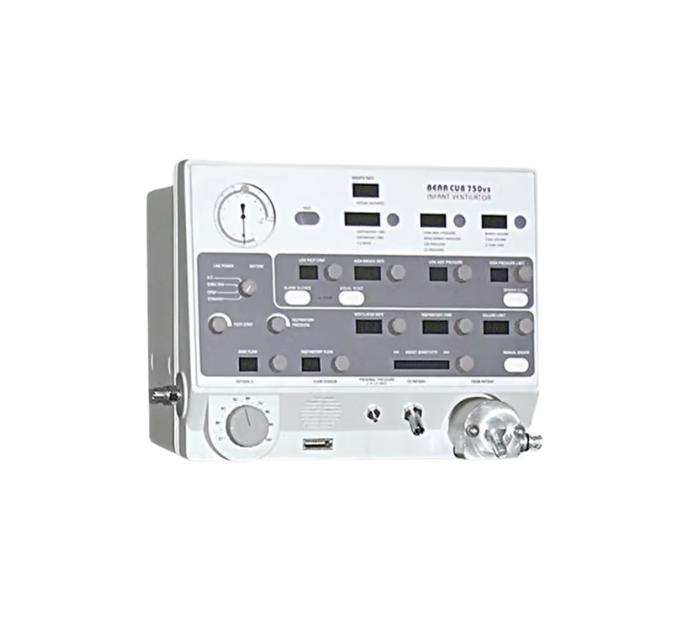
Bear 750 PSV Infant Critical Care Ventilator
The Bear 750 PSV Infant Critical Care Ventilator is an indispensable tool in neonatal and pediatric critical care, offering advanced ventilation techniques that are critical for supporting the respiratory needs of infants with precision and sensitivity. Its specialized features and robust functionality make it a vital asset for healthcare facilities committed to delivering high-quality neonatal and pediatric respiratory care.
Questions About This Product?
Our representatives are waiting to answer any questions you may have.
Features:
Bear 750 PSV Infant Critical Care Ventilator: Advanced Respiratory Management for Neonates
The Bear 750 PSV Infant Critical Care Ventilator is specially designed to provide sophisticated respiratory support to neonates and infants in critical care settings. This ventilator integrates advanced technologies, including Pressure Support Ventilation (PSV), to ensure precise and gentle ventilation tailored to the unique needs of its smallest patients.
Key Features:
- Pressure Support Ventilation (PSV): Optimizes patient comfort and ventilatory support by automatically adjusting pressure to assist spontaneous breathing efforts, reducing the work of breathing for delicate neonatal patients.
- Comprehensive Ventilation Modes: Equipped with a range of modes designed for neonatal care, including volume control, pressure control, and synchronized intermittent mandatory ventilation (SIMV), allowing for flexible treatment options based on specific patient needs.
Enhanced Patient Safety and Comfort:
- Sensitive Triggering Mechanism: Features an extremely sensitive triggering system that detects minimal respiratory efforts from infants, ensuring immediate response and support without overtaxing their fragile respiratory systems.
- Gentle Ventilation Strategies: Provides gentle and protective ventilation to prevent ventilator-induced lung injury, crucial for developing lungs in neonates and infants.
Operational Efficiency:
- User-Friendly Interface: Designed with a clear and intuitive interface that simplifies the management of ventilation settings, enabling healthcare providers to make quick adjustments with minimal disruption.
- Reliable Monitoring: Offers robust monitoring capabilities that provide real-time data on patient respiratory status, ensuring optimal management of ventilation and quick response to any changes in patient conditions.
Durability and Maintenance:
- Durable Construction: Built to endure the demanding conditions of intensive care units, ensuring reliability and long-term performance.
- Ease of Maintenance: Designed for straightforward maintenance, with accessible components and easy-to-clean surfaces that uphold high standards of hygiene and operational readiness.
Clinical Applications:
- Targeted Neonatal and Pediatric Care: Specifically crafted for the intensive care environments of neonates and infants, addressing their critical respiratory requirements from birth.
- Versatile Use Across Hospital Settings: Suitable for use in neonatal intensive care units (NICUs), pediatric intensive care units (PICUs), and during inter-hospital transport, providing continuous support in various care scenarios.
Specifications
Controls
- Mode: AC, Flow cycle AC, SIMV/IMV, Flow Cycled SIMV, SIMV/PSV, PSV, CPAP
- Ventilator Rate: 1.0 to 150 BPM
- Inspiratory Time: 0.1 to 3.0 sec.
- Inspiratory Flow: 1.0 to 30 LPM
- Base Flow: 1.0 to 30 LPM
- Volume Limit: 5.0 to 300 ml
- PEEP: 0 to 30 cmH2O
- Inspiratory Pressure: 0 to 72 cmH2O
- Manual Breath: x One
- Assist Sensitivity: 0.2 to 5.0 LPM; Minimum to Maximum bar
- Over Pressure Relief: 15 to 75 cmH2O
- % O2: 21 to 100%
- Alarm Loudness: Min 60 to Max. 75 dbA
- Audible Off Volume Limit: LED On/Off
Alarms
- High Breath Rate: 3.0 to 255 BPM
- Low PEEP/CPAP: -5.0 to 30 cmH2O
- Low Inspiratory Pressure (vs): 1.0 to 65 cmH2O
- Low Inspiratory Pressure (psv): 5 to 41 cmH2O (derived from High Pressure Limit and Low PEEP/CPAP Alarm Settings
- Patient Circuit: LED On/Off
- Failed to Cycle: LED On/Off
- Low Gas Supply: LED On/Off
- Apnea Alarm: 5, 10, 20, 30 sec
- Settings Incompatible: LED On/Off
- Pressure Settings Incompatible: LED On/Off
- Prolonged Inspiratory Pressure: LED On/Off
- Flow Sensor: LED On/Off
- Low Battery: LED On/Off
- Alarm Silence: 60 sec
- Visual Reset: Push Button
- High Pressure Limit: 10 to 75 cmH2O
- Low Minute Volume: Off to 99 lpm
Monitors
- PEEP: 0 to 30 cmH2O
- Breath Rate: 0 to 255 BPM
- Breath Type (Patient Initiated): LED
- Minute Volume: 0 to 30.0 LPM
- Tidal Volume (Exhaled): 0 to 500 ml
- % Tube Leak: 0 to 100%
- Inspiratory Time: 0.1 to 3.10 sec Expiratory Time 9 to 99.9 sec
- I:E Ratio: 9.9:1 to 1:9.9
- Peak Inspiratory Pressure: 0 to 99 cmH2O
- Mean Airway Pressure: 0 to 75 cmH2O
- Air Pressure: 0 to 100 psig; 0 to 99 psig
- O2 Pressure: 0 to 100 psig; 0 to 99 psig
- Proximal Airway Pressure: -10 to 100 cmH2O
- Hour meter: 0 to 99,999 hours
- Test: Push Button
- Line Power: Green/Red LED
- Battery: LED On/Off
- Inspired Tidal Volume: 0 to 500 ml
Limits to Ventilation (Fixed)
- Minimum Expiratory Time: 0.15 seconds
- Maximum Inspiratory Time: 3:10 seconds
- Maximum settable I:E Ratio: 4:1
TOLERANCES:
Monitors
- Breath Rate: ± 1 BPM or ± 20 msec, whichever is greater
- Inspiratory Time: ± 0.02 sec
- Expiratory Time: ± 0.02 sec
- I:E Ratio: ± 0.1 or ± 20 msec (on the calculation based on the monitored inspiratory and expiratory times), whichever is greater
- Airway Pressure (Continuous):
± 1 cmH2O (-10 to 20 cmH2O)
± 2 cmH2O (20 to 65 cmH2O)
± 3 cmH2O (65 to 100 cmH2O) - Peak Inspiratory Pressure: ± 2 cmH2O or ± 5%, whichever is greater
- Mean Airway Pressure: ± 2 cmH2O or ± 3%, whichever is greater
- PEEP: ± 2 cmH2O or ± 5%, whichever is greater
- Air/O2 Pressure: ± 5 psig
- Minute Volume Accuracy: Based on the Tidal Volume and Breath Rate Monitors
- Inspiratory Tidal Volume: ± 1 ml or ± 10%, whichever is greater
- Expiratory Tidal Volume: ± 1 ml or ± 10%, whichever is greater
- % Leak: ± 1 ml or ± 2%, whichever is greater
(when compared to the Inspired and Expired Tidal Volume Monitors) - Hour Meter: ± 2% of reading
Alarms/Limits
- Low PEEP/CPAP: ± 2 cmH2O
- High Breath Rate: ± 1 BPM
- Low Minute Volume:
± 10 ml/min (0 to 99 ml/min)
± 0.1 L/min (0.1 to 9.9 L/min) - High Pressure Limit: ± 4 cmH2O
- Prolonged Inspiratory Pressure: ± 2 cmH2O
- Volume Limit: ± 2 ml or ± 10% of setting, whichever is greater
- Apnea: ± 1 sec
- Maximum (Pop-off) Pressure: ± 4 cmH2O
Controls
- Ventilator Rate: ± 1 BPM or ± 20 msec (applied to the breath interval), whichever is greater
- Inspiratory Rate:
± 0.020 sec (0.10 to 0.50 sec)
± 0.025 sec (0.50 to 3.00 sec) - Assist Sensitivity: Not a calibrated scale
- PEEP/CPAP and Inspiratory: ± 1 cmH2O or ± 5%, whichever is greater (breath to breath)
- Base/Inspiratory Flow: ± 0.5 LPM or ± 10% of setting, whichever is greater (0 to 60 cmH2O)
- Oxygen %: ± 3%
- Degree of Safety in Presence of Flammable Anesthetics: None
- Mode of Operation: Continuous
Specifications:
| Specification | Value |
|---|---|
| Mode | AC, Flow cycle AC, SIMV/IMV, Flow Cycled SIMV, SIMV/PSV, PSV, CPAP |
| Ventilator Rate | 1.0 to 150 BPM |
| Inspiratory Time | 0.1 to 3.0 sec. |
| Inspiratory Flow | 1.0 to 30 LPM |
| Base Flow | 1.0 to 30 LPM |
| Volume Limit | 5.0 to 300 ml |
| PEEP | 0 to 30 cmH2O |